Checklist of Required Paperwork for a New Jersey REAL ID
A New Jersey REAL ID application can stall when a document is missing, does not match the rest of your paperwork, or is not accepted in the format you brought. Use this checklist to organize the required evidence, understand how the identity points work, and spot questions to confirm with the New Jersey Motor Vehicle Commission before your visit.
New Jersey REAL ID paperwork checklist
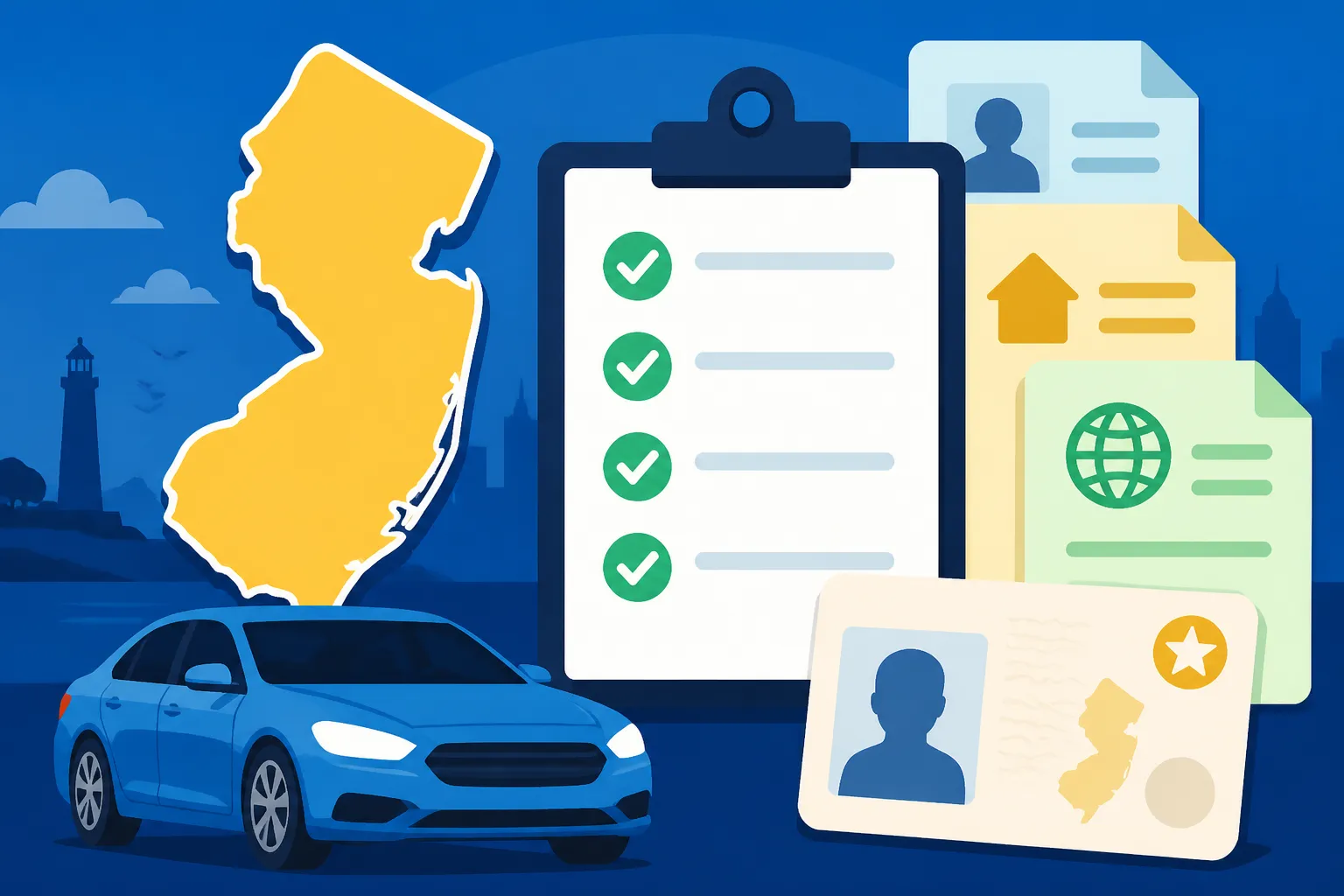
The New Jersey Motor Vehicle Commission’s REAL ID documentation requirements cover three categories: proof of identity, proof of address, and proof of a Social Security number. According to the New Jersey Motor Vehicle Commission, applicants need two address proofs, one valid Social Security number, and identity documents that total six REAL ID points.
| Paperwork category | What the New Jersey Motor Vehicle Commission requires | What to check before your visit |
|---|---|---|
| Identity | Identity documents must add up to six REAL ID points, according to the New Jersey Motor Vehicle Commission. | Check the MVC’s current list of eligible documents and the point value assigned to each one. |
| New Jersey address | Applicants must bring two proofs of address, according to the New Jersey Motor Vehicle Commission. | Confirm which documents qualify and whether the details on them meet the MVC’s current rules. |
| Social Security number | Applicants must bring one valid Social Security number, according to the New Jersey Motor Vehicle Commission. | Confirm what the MVC accepts as proof and check that your identifying details are consistent. |
Treat the table as a planning checklist, not as a list of specific acceptable documents. The MVC’s current document requirements determine which records qualify, how they must be presented, and whether additional conditions apply. A document that seems suitable in everyday life may not meet the agency’s REAL ID rules.
Before gathering paperwork, identify the exact transaction you plan to complete. A first REAL ID application, an upgrade during a renewal, and a replacement credential may involve different steps. The MVC’s instructions for your particular transaction should guide your document choices. For a broad overview of the credential and the process, see Upgrading to a New Jersey REAL ID Driver License.
Make a separate folder or digital planning list for each category, but do not assume a digital copy will be accepted as the document you present. Check the MVC’s instructions for acceptable document formats before you rely on a scan, photograph, printout, or electronic record. The practical question is not merely whether you can show the information on a screen; it is whether the MVC accepts that form of evidence for your transaction.
A useful final check is to compare your selected documents against the current MVC checklist rather than relying on memory, a previous visit, or someone else’s experience. Requirements and accepted-document lists can change. If anything is unclear, resolve it through the official MVC guidance before you travel to a licensing center.
How to build your six points of identity documents
The identity portion is a points-based requirement, not a matter of bringing any collection of identity papers. According to the New Jersey Motor Vehicle Commission, the identity documents provided for a REAL ID must add up to six REAL ID points. The MVC assigns point values to eligible documents, so you need to confirm both that a document qualifies and how many points it contributes.
The six-point rule can be confusing because a document may seem important but still not contribute the value you expect. Do not estimate a document’s point value or assume that a record accepted for another purpose will count the same way for a REAL ID. Use the current MVC point list to select documents that meet the requirement. For more detail on this part of the process, read How the 6 Points of ID Fit into New Jersey REAL ID Requirements.
Choose documents by eligibility and point value
Start with the MVC’s official list of eligible identity documents. Review the point value shown for each candidate, then total the values using only documents that meet the stated conditions. If a document has qualifications attached to it, read those closely. A name mismatch, expired document, missing supporting record, or unacceptable format could affect whether it can be used.
Avoid choosing a document just because it contains your name or photograph. Those features do not, by themselves, establish that the MVC will accept it or assign it the point value you need. The question is whether the document appears on the MVC’s current REAL ID list and satisfies the requirements printed there.
A simple planning sheet can help:
- Write down the identity documents you are considering.
- Record each document’s point value from the MVC’s current list.
- Note any conditions that apply to the document.
- Add the points and confirm the total meets the MVC requirement.
- Mark any item that needs a supporting record or format check.
This planning step is especially useful if you have documents with different versions of your name, older records, or records issued by different organizations. It gives you time to resolve uncertainty before your appointment rather than discovering a problem at the counter.
Check names and supporting records
Compare the names shown on your identity documents with the name you intend to use for the application. Small differences may be explainable, but do not assume the MVC will treat every variation as interchangeable. A missing middle name, different surname, spelling variation, or name change can prompt a request for more documentation, depending on the MVC’s rules and the documents involved.
If your identity paperwork uses different names, check the MVC’s guidance before you go. The article Name Matching Rules Between Social Security and ID for NJ REAL ID may help you identify where name consistency matters. For a legal name change, check the agency’s instructions for the records it expects rather than relying on an informal explanation.
Also check whether an identity record needs another document to support it. Some records may only work when paired with specified evidence. The MVC’s current list should explain whether such a condition applies. Do not count a document toward your points until you have checked the complete requirement, including any pairing or validity rules.
Do not substitute documents based on guesswork
A common paperwork mistake is to bring a collection of documents that feels comprehensive without confirming that the combination qualifies. More paperwork does not automatically mean the identity requirement is satisfied. An extra record may not contribute points, and a seemingly strong document may be ineligible for the purpose you have in mind.
If the MVC checklist does not clearly answer whether a document qualifies, pause and confirm the rule through the agency’s official guidance. This is more reliable than relying on a friend’s past application, an online discussion, or a document list intended for a different MVC transaction. Keep a note of what you verified and which documents you plan to use so you can review the combination before leaving home.
Gather two acceptable proofs of New Jersey address
Address proof is a separate category from identity points. According to the New Jersey Motor Vehicle Commission, applicants must bring two documents as proof of address to get a REAL ID. Having a document that includes your address does not automatically make it acceptable; the MVC’s current list and conditions determine whether it qualifies.
Start by checking the MVC’s accepted address-document list. For each document you are considering, verify that it is an eligible type of record, that it shows the required information, and that it meets any date or format conditions the MVC specifies. These details matter because an otherwise genuine record may be too old, incomplete, or presented in a form the agency does not accept.
A bank statement or utility bill may seem like an obvious choice, but do not assume that every version or delivery format qualifies. The MVC may set conditions for particular records. You can review Using Recent Bank Statements and Utility Bills for NJ Address Proof for document-specific considerations, then confirm the current rules with the agency.
Check that the documents support the same application
Before relying on an address document, examine the name and address printed on it. Confirm that the record is associated with you and reflects the address you will provide for the application. If the document is shared with another person or uses a different version of your name, check whether the MVC accepts it in that situation.
Make sure the address is complete and readable. A record with a missing unit detail, an old residence, or an unclear printout may create questions even if the document type is otherwise eligible. If an institution abbreviates or formats your address differently, compare that version with the address information you will submit and check the MVC’s instructions for any mismatch.
Do not rely on a document simply because it was accepted for another purpose. A record used for a vehicle transaction, school registration, insurance application, or previous license transaction may not necessarily satisfy the REAL ID address requirement. Confirm that the document is accepted for this credential and meets the current conditions.
Think about recent moves and limited paperwork
If you have recently moved, your records may not all show the same address yet. That is a reason to review the MVC’s accepted-document list carefully, not to assume that a temporary explanation will replace the required proof. Look for eligible records that reflect your current residence and check whether the MVC sets a recency condition for each document type.
If you live with another person or do not receive bills in your own name, do not count a household member’s paperwork without checking whether the MVC allows it and what supporting documents it may require. The same caution applies if you receive most statements electronically or have recently changed the address on your accounts. The form in which a record is issued can matter, so verify whether a downloaded statement, mailed record, or other version is acceptable.
For a broader overview of planning an in-person visit, see Checklist for Preparing Your First In-Person NJ MVC Agency Visit. That preparation can help you keep address evidence together with your other application materials, but the REAL ID document rules still control what qualifies.
Bring proof of a valid Social Security number
The Social Security requirement is its own checklist item. According to the New Jersey Motor Vehicle Commission, applicants must bring one valid Social Security number to obtain a REAL ID. Do not treat this as automatically satisfied just because your number is already recorded somewhere in an account or appears on another document.
Check the MVC’s current instructions for the proof it accepts. The required item may depend on the type of record you have and the details shown on it. Confirm that the evidence meets the agency’s rules for a REAL ID application, rather than assuming that any document containing the number will work.
Review names and identifying details
Before your visit, compare the identifying details on your Social Security evidence with the identity documents you plan to use. Look for differences in your name and other information that could lead to a question about whether the records refer to the same person. If you have had a legal name change or your records do not match, check the MVC’s instructions for the supporting documentation it requires.
The article Name Matching Rules Between Social Security and ID for NJ REAL ID can help you think through common matching issues. It is still important to confirm the current agency requirements for your individual documents. Do not assume that an explanation alone will resolve a mismatch.
Protect personal information while you organize your paperwork. Keep sensitive records in a secure place, and avoid sending or displaying them unnecessarily. At the same time, do not alter an official document in a way that could make it unacceptable. If you have a privacy concern about information visible on a record, check the MVC’s instructions before redacting or covering anything. Protecting Financial Privacy on Papers Brought to the NJ MVC covers a related concern about handling personal information on paperwork.
Check acceptable formats in advance
A photograph or electronic record may be convenient for planning, but convenience does not establish that the MVC accepts it as proof. Check whether the agency requires a particular form of the document, such as an original, a printed record, or another specified format. Do not rely on a screenshot or photocopy unless the MVC’s current instructions say it is acceptable for that item.
For more on the format question, see Are Digital or Electronic Copies Allowed for NJ REAL ID Applications?. You can also review Presenting Unlaminated Original Documents at the NJ MVC if you are unsure how the agency treats physical records. Follow the current instructions for each document instead of assuming that one format rule applies to every category.
Prepare your paperwork and avoid a wasted visit
Once you have chosen documents for all three categories, check the entire set together. The identity records must satisfy the point total, the address records must meet the address requirement, and the Social Security evidence must meet its own requirement. According to the New Jersey Motor Vehicle Commission, the REAL ID documentation package consists of two address proofs, one Social Security number proof, and six points of identity documents.
Use a final review routine
Before leaving, compare every document with the MVC’s current checklist. Confirm that each item is intended for the correct category and that you have not counted a record twice without the MVC’s instructions allowing it. Review names, addresses, document validity, supporting records, and presentation format.
A practical review can look like this:
- Verify that your identity documents meet the six-point requirement.
- Verify that you have two eligible address proofs.
- Verify that your Social Security evidence meets the MVC’s instructions.
- Check that names and addresses are consistent or that you have the required supporting records.
- Confirm whether each document must be original, printed, or presented in another specified format.
- Check the MVC’s current instructions for the transaction and licensing center you plan to visit.
The point is to identify questions while you still have time to address them. If the MVC’s instructions are unclear about a particular document, confirm its status through the agency before your visit. Do not make a last-minute substitution based on what seems equivalent.
Keep the paperwork organized
Separate identity, address, and Social Security evidence so you can find each item quickly. A folder with clearly marked sections can help, provided you do not put adhesive labels or anything else on an official document. Keep supporting records with the document they relate to, and use a private checklist to remember why you selected each item.
If you are bringing financial records, consider what personal information they expose and how you will store them while traveling. Do not remove or obscure information unless the MVC’s instructions permit it. The safest approach is to ask the agency how it wants a document presented when privacy and document integrity seem to conflict.
Confirm the visit details with the official agency
REAL ID paperwork is only one part of preparing for an application. Check the MVC’s current instructions for the required transaction, appointment or walk-in rules, and the type of center that handles your service. Do not assume that every MVC location processes every licensing transaction. Use the official agency’s office locator to find a suitable location and its current hours.
For appointment planning, REAL ID Appointments: Document Preparation for NJ Agency Visits may help you organize the visit. If your plan involves upgrading an existing credential, How to Renew Your Eligible New Jersey Driver License Online may clarify whether your renewal situation has a separate process. Online renewal eligibility and REAL ID paperwork are not interchangeable, so confirm the steps for the transaction you actually need.
Bring only what the MVC asks you to present, but do not leave out a required supporting record. An orderly, verified set of paperwork can reduce avoidable delays, while guessing about document eligibility can lead to a return trip. If the agency’s instructions change or your circumstances are unusual, check the current official guidance again before you travel.
Frequently Asked Questions
What paperwork categories are required for a New Jersey REAL ID?
According to the New Jersey Motor Vehicle Commission, applicants need identity documents totaling six REAL ID points, two proofs of address, and one valid Social Security number. Check the MVC’s current list to confirm which specific documents qualify.
Can I use any document with my name and address as proof of residence?
No. A document containing your name and address is not automatically an accepted REAL ID proof. Confirm that the document type and its format meet the New Jersey Motor Vehicle Commission’s current requirements.
How do I know whether my identity documents add up to six points?
Use the MVC’s current identity-document list and point values. According to the New Jersey Motor Vehicle Commission, the identity documents submitted for a REAL ID must total six REAL ID points. Do not estimate values or count a document unless it meets the listed conditions.
Should I bring electronic copies of my documents?
Check the MVC’s current instructions for each document before relying on an electronic copy, screenshot, or printout. Accepted formats may differ by record, so do not assume that a digital version will be accepted.
What should I do if my documents show different names or addresses?
Review the MVC’s instructions for mismatches and any supporting records it requires. If the instructions do not clearly cover your situation, confirm the requirement with the official agency before your visit rather than assuming an explanation will be enough.
Sources
- New Jersey Motor Vehicle Commission — NJMVC REAL ID (checked November 11, 2026)
Disclaimer
This article is for general informational purposes only and does not constitute professional advice. Laws, prices and regulations vary by location and change over time. Consult a qualified professional for guidance on your specific situation. New Jersey Driver Guide is not a government agency and is not affiliated with any state motor vehicle department.